
Niobrara County Historical Map and Legend
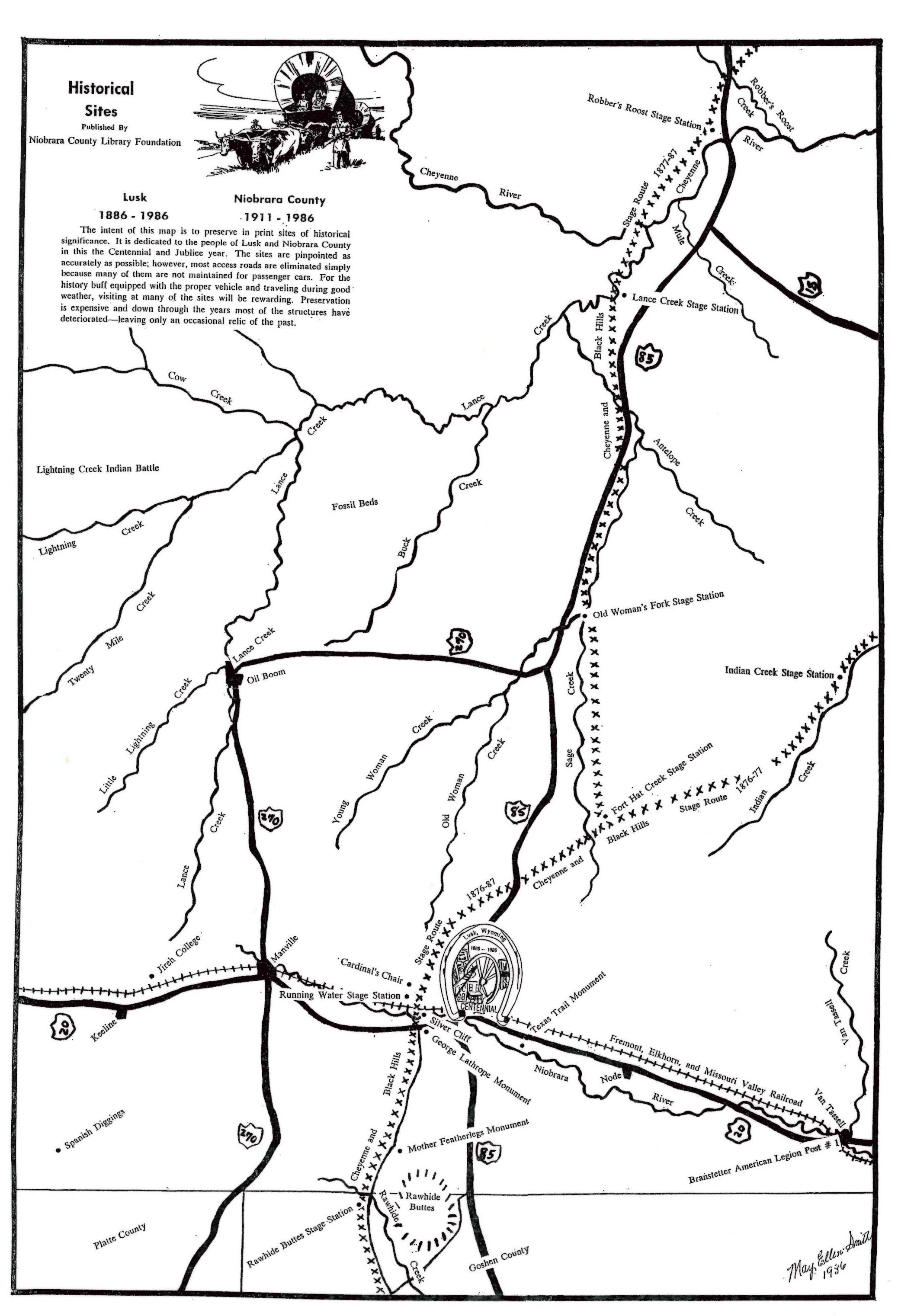
Map and notes created by May Ellen Smith for the Niobrara County Library Foundation in 1986.
Historical Notes
BRANSTETTER AMERICAN LEGION POST #1, VanTassell, was established on June 28, 1919. It was the first post in Wyoming and one of the first four in the United States. It was named for Ferdinand Branstetter who homesteaded south of Van Tassell in 1914. He was the first to die on the battlefields of France.
CARDINAL’S CHAIR, located 1/2 mile west of Lusk, is an early day landmark of eroded sandstone formation.
CHEYENNE AND BLACK HILLS STAGE LINE was established as a result of the Black Hills gold rush. Gilmer and Salisbury, owners, old-time overland stage men delegated full authority for the actual setting up and running of the line to Luke Voorhees. Stations were located about 15 miles apart. The first stages left Cheyenne on April 5, 1876. From then on stages left Cheyenne and Deadwood on a daily schedule, carrying the United States mail, express, and passengers. The trip from Cheyenne to Deadwood, which was continuous night and day with stops only for meals and changes of horses, required a little over three days. Gold shipments were usually sent out in a special armored six-horse coach under guard of four to six messengers. Russell Thorpe Sr. purchased the line in 1883, and it continued to run until the coming of the railroad made its services no longer necessary. The last official run was made on February 19, 1887, with George Lathrope holding the reins.
FREMONT, ELKHORN, AND MISSOURRI VALLEY RAILROAD, now the Chicago and North Western, reached Lusk on July 13, 1886. A big celebration was held. The main feature was a silver spike, made from local mines, and driven in with a copper hammer made from the copper mines in the Rawhide Buttes area.
FORT HAT CREEK STAGE STATION, located 15 miles north, 2 miles east, 1 mile south of Lusk, was established in 1875 when Captain James Egin and his cavalry troops thought they had reached Hat Creek in Nebraska. It then consisted of L-shaped barracks with a tunnel connected to Sage Creek so water could be obtained during time of siege. In 1876 it became a stage stop on the Cheyenne-Black Hills Stage Route. It also served as a hotel, blacksmith shop, telegraph station, and post office, established February 2, 1877. The original building burned in 1883 and was replaced by the present two-story building.
FOSSIL BEDS, located north of Lance Creek, were discovered in the late 1880’s by paleontologist John Bell Hatcher and fellow scientist Othniel C. Marsh. This vast region is a treasure chest of triceratops, trachodons, and mesohippus as well as small camels, rhinoceroses, sabre-toothed tigers, oredons, and many other species. It has the distinction of being where the first dinosaur fossils were found in the United States.
GEORGE LATHROPE MONUMENT, located 1 1/2 miles west of Lusk, was dedicated as a memorial on May 30, 1930, to George Lathrope, born December 24, 1830, and died December 24, 1915. A veteran stage driver he had the honor of being the last driver “to hold the ribbons” as the Cheyenne and Black Hills Stage Line made its last run on February 19, 1887.
INDIAN CREEK STAGE STATION, located some 15 miles north and 15 miles east of Lusk, was a regular meal and telegraph station in 1876. Here a man named Harding had excavated a dugout for a dwelling and covered it with a thatched roof. A clay bank served as one side and the back of the stage station while the other side and the front were constructed of logs.
JIREH COLLEGE, located 15 miles west of Lusk, was the first junior college in Wyoming. The two and one-half story frame building took its name from the town of Jireh, founded in 1908 and now a ghost town, which was a biblical name meaning “the Lord will provide”. The college opened in 1910 and closed in 1920.
KEELINE, located 17 miles west of Lusk, was founded in 1886. Keeline was named for George A. Keeline, a pioneer rancher whose brand was the 4 J.
LANCE CREEK, first appeared as a named creek on an 1860 map. It was named for the black, or water ash which then grew along its banks and was used by the Indians to make lances. The community came into existence in 1917 when the discovery of rich oil pools in the surrounding area heralded a boom. One company, Union Oil of California, leased twenty thousand acres between Buck Creek and Twenty Mile Creek.
LANCE CREEK STAFE STATION was established about 38 miles north of Lusk in 1877 at the Jim May ranch on Lance Creek.
LIGHTNING CREEK INDIAN BATTLE took place on October 31, 1903, approximately 50 miles northwest of Lusk. It was the last armed engagement between the Sioux Indians and the white men. The Indians had been violating hunting laws. Sheriff William Miller of Newcastle, his deputy Louis Falkenburg, and several Indians were killed. No action was taken against the Indians.
LUSK was founded in 1886 and named after Frank Lusk who donated the land for the town site. A public auction of 40 lots was held on July 20, 1886, a week after the railroad reached Lusk.
*The first post office was established on February 15, 1884, with Frank Lusk as postmaster. Although known as Lusk Post Office, it is thought that the actual location at that time was the Running Water Stage Station.
*The first church was the Congregational Church. Services were held in 1886, but it was not until the spring of 1877 that it was organized and the building erected from lumber milled in the Rawhide Buttes.
*The first school was held September 6, 1886, in a “tabernacle” which had been set up for church services. A few months later a wooden building was erected.
*The first building erected was Ellis Johnson’s “Iron-clad Store”. It got its name because the sides were covered with galvanized metal. It was built at Silver Cliff and moved to the Lusk town site in the fall of 1886. The front part of the building now stands on the grounds of the Stagecoach Museum.
*The first log cabin in the area, built by Eugene Willson in 1880, now stands at the George Washington Memorial Park in Lusk.
*The first brick building was the house built for Mrs. Cornelia Lusk, the mother of Frank Lusk. It is now Peet Mortuary.
*The first homestead, patent number 6709, was issued May 25, 1883, to George W. Newton. It was signed by President Chester A. Arthur, and the land lay on and in the vicinity of Mining Hill, west of Lusk.
*The old Wooden Water Tower east of Lusk was erected in 1886 by the railroad and supplied water to the steam engines. It is the only one still standing in Wyoming, and one of six remaining wooden towers in the United States.
*The Yellow Motel, a ten-room bordello, was “one of the most famous in the Rocky Mountain area”. It was operated from 1919 until 1979 by Dell Burke, known for her generosity in giving money for civic improvements and charity.
*The Stagecoach Museum, located on Main Street, houses one of the original stagecoaches used by the Cheyenne and Black Hills Stage Line as well as other memorabilia of Niobrara County’s past.
*The Lusk Herald is the oldest weekly newspaper published in Wyoming still operating under the original name. It was started on May 20, 1886, by J.K. Calkins in a tent at Silver Cliff.
LEGEND OF THE RAWHIDE PAGEANT was first presented in 1946, and in 1986 the pageant was part of the Lusk Centennial celebration. This pageant is based on a story of a man being skinned alive by Indians. The story first appeared February 2, 1850, in the Lacon, Ill., “Gazette”. It was printed to discourage people from going west and was later retracted, but by that time the myth had spread. The name of the victim differs from locality to locality.
MANVILLE, located 10 miles west of Lusk, was founded in 1886 and was named for H.S. Manville, organizer of the Converse Cattle Company in the early 1880’s.
MOTHER FEATHERLEGS MONUMENT, located 2 miles west and 10 miles south of Lusk, was dedicated on May 17, 1964, as a memorial for Mrs. Sheppard, a colorful road-house madam. Her long, red, ruffled pantalettes, made her “look like a feather-legged chicken in a high wind” when she was astride a horse-thus her nickname “Mother Featherlegs”. Her place near Demmon Hill on the Cheyenne and Black Hills Stage Route operated from 1876 to 1879. A neighbor lady, Mrs. O.J. Demmon, found her murdered. She had been shot in the back while filling a bucket at the spring near her dugout.
NIOBRARA RIVER first appeared in a government treaty with the Pawnee Indians in 1853. The name is derived from two Indian word; “ni” for water and “obthatha” for spreading. It is also known as Running Water. During the Civil War period, a sizable army of Confederate prisoners known as “Galvanized Yankees” explored this region under the command of Union officers and camped near the site of Lusk. It is from this river that the county took its name when it was formed in 1911. Three flags have flown over this river and the country that is now Niobrara County, those of Spain, France, and the United States. It has been part of six territories, Louisiana 1803-1812, Missouri 1812-1854, Nebraska 1854-1863, Idaho 1863-1864, Dakota 1864-1868, and Wyoming 1868-1890. It has also been part of two other counties -- Laramie and Converse.
NODE, located 12 miles east of Lusk, was named for the Node ranch and brand which was established in 1880 by Frank Lusk. It became a post office in 1910 with Peter Hansen as postmaster.
OLD WOMAN’S FORK STAGE STATION was established in 1877 where Sage Creek runs into Old Woman Creek which is named for an old Indian woman who disappeared and later returned in spirit to dance in the moonlight on the rimrocks above the creek.
RAWHIDE BUTTES AND CREEK offered natural shelter and water and the area was long a favorite camping place for both Indians and trappers. It was here that the white man bargained for beaver pelts and buffalo hides. After being pressed, the hides were salted preparatory to shipment, then loaded on travis or pack horses and taken to the mouth of Rawhide Creek where it empties into the Platte River. It was from this activity that the buttes and creek received their name. Some of the fur presses were still there as late as 1883. In the early 1880’s copper mining and sawmill operations were also carried on in this area.
RAWHIDE BUTTES STAGE STATION, located approximately 15 miles south of Lusk, was first established in 1876 by J. W. Dear. It was soon burned by Indians and was rebuilt in 1877. When Russell Thorpe Sr. acquired the Cheyenne and Black Hills Stage Line, it became the home station. It also served as store, post office, blacksmith shop, telegraph station and hotel.
RUNNING WATER STAGE STATION was first established about 1 mile west of Lusk in 1876 by J. W. Dear and was soon burned by Indians. Jack Madden then built a large stone barn with a pole and dirt roof. This station was very important for it was here that the cattle barons came to inspect the trail herds on their way north.
ROBBER’S ROOST STAGE STATION was established some 50 miles north of Lusk in 1877 and was located between the Cheyenne River and Robber’s Roost Creek where steep banks lined with timber and brush provided ideal concealment for outlaws to ambush the stages. It was burned in 1886 by Indians and never rebuilt.
SILVER CLIFF was located about a mile and a half west of Lusk. Silver and copper mining were carried out at Mining Hill from 1880 until 1898. The Great Western Mining and Milling Company operated a large stamp mill on Mining Hill from 1884 to 1898. In 1885 there was a tent town of 200 people, but they all moved to the Lusk town site when the railroad arrived in 1886.
SPANISH DIGGINGS, located south of Keeline, were discovered in the 1870’s by cowboys and misnamed because it was thought that the Spaniards had dug for gold there. Scientists declared the 400 square mile area a prehistoric site, probably 10-15,000 years old.
TEXAS TRAIL MONUMENT, located 3 miles east of Lusk, was dedicated in August of 1940 to mark the wide trail over which thousands of head of cattle passed on their way form Texas to summer ranges in the north from 1876 until 1897.
VAN TASSELL, located 20 miles east of Lusk, was founded in 1886 and named for Van Rensselaer Schuyler Van Tassell, pioneer rancher. When it was used as a supply point for the settlers in the early 1900’s it was also known as “Homesteaders’ Landing”.