
Black, Tom: Biography
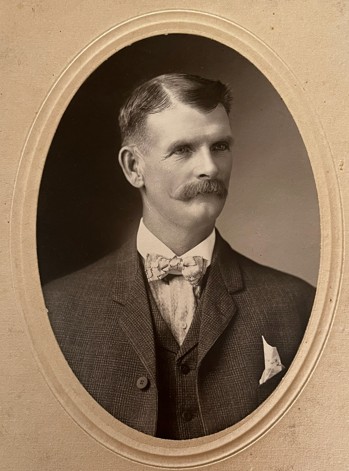
With the passing of the years the ranks of the old timers are thinning rapidly and soon the last of those who helped settle the old west will be no more. Many interesting incidents occurred during the early days and it was my good fortune to observe or be a participant in many of them. Born in New York City June 4, 1861 the early years of my life were spent on a small farm at Richmond, Staten Island, then a suburb of New York but now included in Greater New York City. Until I was fifteen I attended a country school on Staten Island and then started out to earn my own living. After serving as an office boy in various wholesale mercantile firms, I entered the employ of the Pennsylvania railroad company and was stationed for two years at one of their North River piers in the freight department.
Tiring of the monotony of office work I answered the call of the wide open spaces and determined to go west. I informed my employers of my decision and they gave me a railroad pass over their line to Chicago. Arriving in Chicago, I boarded a Union Pacific train and landed in Cheyenne, Wyoming in May 1882.
Cheyenne at that time was a typical cowtown of the early days-wild and wooly. There were plenty of saloons and cowboys, together with freighters, and all the others that went to make up a frontier town. There were plenty of opportunities for those who sought a future in the livestock business and after investigation I found that the WH called outfit on Rawhide creek was shorthanded and had advertised for men. The next problem was how to reach the WH. Inquiry revealed that the only means of transportation was the six horse team stage coach which also carried the mail between Cheyenne and Deadwood, South Dakota. The state line was operated by the Cheyenne and Black HIlls Stage and Express company. I secured a seat on the coach to a station known at that time as the “Government Farm”. This station was about half-way between Rawhide Buttes and Fort Laramie. En route to the Government Farm, I became acquainted with Tom Duffy, the stage driver, a pleasant and agreeable fellow, one of the “dandies” of the line and an expert driver. Duffy explained many things to me en route. Coming from a city, everything was new to me and I found many things to excite my interest. Duffy told me I could borrow a horse at the Government Farm and ride out to the WH ranch. At the government farm where I secured a horse and saddle, they gave me instructions as to how to reach the ranch and I was told upon my arrival to ask for Amos Spaugh who was the foreman.
Told to travel in a general northeast direction, I soon became badly confused as there were no roads to follow. I rode all that day, without locating the WH ranch, realizing indeed that I had found the wide open spaces which I had been seeking but a little less space and a few signs of habitation would have been most welcome. Towards evening a small homestead cabin loomed in sight and I rode towards it in the hope of securing directions that would put me on the right trail to the WH ranch. Arriving at the cabin I found it deserted so mounted my horse again and set out in the direction in which I thought the ranch might be. Eventually after many weary hours in the saddle I found a water hole which was a cheering sight as I had been without water all day. I dismounted and knelt down by the side of the water with the horse thrusting his muzzle deep in the refreshing water beside me. In starting to mount again, the horse broke loose and disappeared in a lope over a hill, leaving me alone in the midst of a strange land-hungry, tired and worst of all, not having the slightest idea of where I was. I ran after him but realized that it was hopeless, I returned to the deserted cabin where I made myself as comfortable as possible under the circumstances.
Rising early the next morning with an increasing sense of hunger, I started walking. About noon I came upon a recently deserted roundup camp where I found a shank bone of beef. How good it looked and I managed to appease some of my hunger. It had been a day and a half since I had eaten. I started walking again, mile after mile and the hours dragged by. My feet became sore and swollen and each step was agony. It was with great rejoicing that I discovered a cowboy with a string of saddle horses riding towards me. Never was I more glad to see a human being.
I explained the loss of my horse, telling the cowboy I was on my way to the WH ranch. He told me that I had wandered many miles off the trail and that it would be a long walk to the WH ranch. He observed that my horse had probably headed straight back for his home corral at the Government Farm. This news and the fact that I had borrowed the horse made me change my plans of going on to the WH ranch. I wanted to be sure the horse had returned to its owners so I decided to return to the Government Farm. I informed the cowboy of my decision and he offered to let me ride one of his horses as far as Fort Laramie, and then I could go on from there to the Government Farm on the stage or with some freight outfit. He made a rope hackamore (or bridle) and I mounted the animal bareback. Unaccustomed to riding and after my experiences of the day before, this was anything but a pleasant ride but was only too glad to get out of the predicament I was in.
On arrival at Fort Laramie my cowboy friend and I parted and I started to take in the sights of the old Fort and trading post. Fort Laramie at this time was an active military post and a very picturesque one with its officers’ quarters, barracks and corrals. The corrals quartered the cavalry horses of the troopers. In addition to being a military post, it was also a stage station, a government post office, settler’s store and general trading post. All merchandise and supplies were freighted to the Fort and store from Cheyenne by jerk-line outfits and bull teams.
The fort was closely identified with the early history of Wyoming and was the scene of many activities connected with the wagon trains when attacked by Indians on the trail, while en route to the gold fields of California. The soldier cavalry stationed there were often called out to protect these immigrant trains from attack and raids by war parties of Indians.
It was named Fort Laramie, or Laramie’s fort in honor of a French voyageur and trapper by the name of LaRame who was killed by Arapahoe Indians in that vicinity. The same station or one nearby was previously called Fort John and was rebuilt about 1836 by the American Fur company, until 1865 when Fort Conner (Reno) was established, Fort Laramie was the most northerly United States military post on the plains. Many immigrants passed by there on the Oregon trail from the early ‘50s on.
It was here that I met for the first time Harry P. Hynds, now owner of the Plains hotel in Cheyenne. He was the blacksmith and shot the horses for the stage line.
The settlers store, as it was called, was a meeting place for freighters, cowboys and miners and many interesting incidents took place there. The jerk-line teams, used to freight supplies from Cheyenne, consisted of six to eight-horse teams, strung out, one team ahead of the other and their movements were guided by what was called a jerk-line. The driver generally rode the right horse of the wheel team, or the team hitched to the wagon tongue of the freight wagon. Other wagons were towed or trailed behind this wagon and were known as “trailers”. They were coupled to the wagons ahead of them by short tongues or poles. Freight outfits hauled from two to four wagons, fastened together in this way. The settlers' store during this period was run by R.A. Hart, who was one of the earliest settlers in Wyoming.
I remained a few days in Fort Laramie, not being able to connect with anyone going north. Then the stage arrived and I again met my friend Tom Duffy and related my mishap to him. Tom smiled and assured me it was not uncommon for a rider to lose his horse and that many an experienced plainsman had been left afoot by being careless and letting his horse get away. Duffy advised me to go on to Rawhide Buttes on the stage as he had heard that the foreman of the Luke Voorhees Cattle Company was at the Buttes looking for men.
So I boarded the stage for Rawhide, stopping at the Government Farm where I found, much to my peace of mind, that the saddle horse I had borrowed had returned safe and sound.
On arrival at Rawhide Buttes I met Mack Jester, who at that time was foreman of the Luke Voorhees Cattle Company. He engaged me as a horse wrangler and I left with him for the Voorhees headquarters or what was known as the LZ outfit. The Voorhees Cattle Company had its ranch on Runningwater above where the town of Van Tassell now stands. They also had large land and ranch holdings on Rawhide creek where the Wolfe ranch is now located. I worked some time with the LZ outfit as a horse wrangler and later as a cowboy, leaving to enter the employ of the Cheyenne and Black Hills Stage company as station agent at Rawhide Buttes.
In 1876, following abandonment of the Pony Express, Gilmer, Salisbury and Company established and operated the Cheyenne and Black HIlls stage line between Cheyenne, Wyo., and Deadwood, S.D., with the Late Luke Voorhees as general superintendent.
About 1880, Gilmer, Salisbury and Company sold their interests in the stage line between Cheyenne and Deadwood to Luke Voorhees, who continued to operate the line until about 1882 when he sold it to Russell Thorp, Sr. Thorp was also operating a line between Douglas and Wendover, Wyo. The line was operated under Thorp’s management until 1886 when the Chicago and Northwestern railroad built a line from Fremont, Neb., to Lander, Wyo., and the Cheyenne and Northern, now the Colorado and Southern, build a line from Cheyenne to Wendover, Completion of the railroad lines took care of express and passenger business, causing gradual abandonment of all stage lines.
During operation of the stage lines, stage robbers, popularly known as “road agents” were numerous, causing much trouble, not only to the owners of the line but to the passengers, who were relieved of money and jewelry. During such holdups, however, their main objective was the treasure chest. The stage company had several special steel covered coaches for the protection of the express messenger and passengers. The coaches carried a steel safe, or as it was commonly called, a treasure chest, which was riveted to the body of the coach. The coaches thus came to be called mail treasure coaches. They were used to carry passengers and gold bullion from Deadwood to Cheyenne or vice-versa as the way bills might show.
Gold was first discovered in the Black Hills on French creek, near where the city of Custer stands today by Horatio N. Ross in July 1874. Ross was one of the prospectors and scientists with Custer’s expedition to the Black HIlls in that year. This expedition was for the purpose of making a thorough exploration of the Black HIlls country and was the largest and best equipped military expedition ever sent into the northwest, consisting of over a thousand men, several hundred wagons and other equipment.
The expedition left Fort Lincoln, Dakota territory, July 2, 1874, going through northwestern Wyoming in what is now Crook and Weston counties. They arrived on French creek the last of July.
There had been rumors of gold in the Black Hills for some time but it had never been verified, until the prospectors of Custer’s command started to dig and pan out pay dirt on French creek. Charlie Reynolds, a scout who General Custer sent with dispatches to Fort Laramie, a distance of over two hundred miles, through hostile Indian country, told of gold being discovered on his arrival at the Fort. It was not long before there was a steady stream of humanity from every direction to the new gold field. The Indians resented this intrusion on their rights and exacted a heavy toll of lives, as the many grass covered mounds along the Cheyenne and Black Hills trail show. It was not long before the rush into the Black HIlls rivaled the California rush of ‘49.
The largest gold mine in the world today, known as the Homestake mine at Lead, South Dakota, was discovered by two young French prospectors in the fall of ‘75. They located the claim and after taking out considerable gold, sold out to a Mr. Hearst, a mining man and father of William Randolph Hearst, owner of a number of newspapers and magazines in the present day. The ore from the mines was taken over the mountains by mule and string teams to Central where there was a stamp mill which was kept busy night and day. Gold and bullion was also carried by the Cheyenne and Black Hills stage line in steel coaches to Cheyenne, Wyo.
One of the first drivers on the line was a young man named Jimmy Slaughter. He was reared in Cheyenne and was well known in the capital city at that time. Slaughter was shot and killed on one of his trips by road agents who expected to secure gold and valuables and money from passengers. Later a road agent named Dunk Blackmore was caught, tried and convicted and given a sentence of ten years in the penitentiary. The evidence was largely circumstantial and Blackmore denied the crime, many people believing in his innocence.
Another famous western character in Kansas, Cheyenne and Deadwood was James B. HIckok, better known as “Wild Bill”, of whom much has been written, owing to his quick action with a six shooter. He came to Cheyenne and later to Deadwood in the summer of ‘76. He had served as a marshall in western Kansas where he had made a record cleaning out bad characters.
He was finally shot in the back while sitting in a card game with his back to a window by a man named Jack McCall. McCall was given a camp trial by a jury of gamblers and was acquitted. He was given enough money to leave the country. Later Hank Beeman, a U.S. marshal and a close friend of Hickok, et McCall while going through Chugwater, Wyo., and arrested him, taking him to Yankton, S.D., where he was tried on charge of murder, convicted and sentenced to be hung.
Hickok had also served as a government scout during the Civil war and later in several campaigns against the Indians. He was an inveterate gambler and a quick shot. He was never known to take an advantage in any situation in which he found himself.
In the fall of 1876 a large shipment of gold was sent out by stage to Philadelphia and at that time the nearest government mint. The shipment went to Cheyenne and from there by railroad to Philadelphia. Luke Voohrees, superintendent of the line, accompanied the shipment. He was heavily armed and strapped himself on the platform in the rear of the coach in order to more readily protect the gold. Six armed guards were also taken to repel any attack by road agents. In only one instance on the trip was the party molested by road agents who planned to rob the treasure chest. After firing a few shots in which no one of the stage crew was seriously injured the road agents saw they were outnumbered and made a hasty retreat, carrying with them one of their number who was badly wounded. The gold shipment represented a large sum of money and the news of the trip to Cheyenne was a closely guarded secret.
Scott Davis was chief of the guards or messengers. He was known throughout the line as “Quick Shot” Davis, a man of iron nerve and a sure shot with a six-shooter or rifle. In many daring holdups, staged by road agents, Davis and his messengers never failed in their duty to protect the passengers and treasure. Occasionally they were outnumbered and the road agents were able to secure the treasure from the chest, money and valuables from the passengers and then flee to their hold out in the mountains.
Among the messengers who served under Davis were Dale Hill, Boom, Jim May, Jesse Brown, Scott Jenks and Captain Smith, all brave and fearless men, excepting the last named, who did not display the courage and nerve necessary to hold his job and was not retained long as a guard.
The Cold Springs stage robbery, which was among many which took place, was fully described by the late Luke Voorhees, owner of the stage line at that time. Voorhees’ story of the holdup is as follows:
“The morning of Sept. 19, 1878, our Cheyenne and Black Hills treasure coach (as it was called), as I permitted no passengers to ride on the coach that carried the gold bards, left Deadwood for Cheyenne with $37,000 mostly in gold dust and gold bars, there being only $3,500 in currency, in charge of Scott Davis, captain of the armed guards or messengers, who on that day were Scott Davis (captain), Gale Hill, Captain Smith and Donald Campbell, messengers: Mr Ward, division superintendent, to whom I had given specific order to accompany the treasure coach to Hat Creek station, which took 48 hours, day and night.
“Ward only remained with the coach to the Pleasant Valley dinner station where he turned back to Deadwood, disobeying my orders. On the arrival at the first station south of Pleasant Valley, which was Cold Springs, about 3 o’clock in the afternoon, broad daylight, the driver pulled up to the front of the barn where the stock tender would usually be standing ready to unhitch the six horses, and change for six others (which usually was done in seven minutes).
“The stock tender not being in sight, Gale Hill, who was riding with the driver, after having called to the station tender, jumped down to see what had become of him, when the road agent, who had knocked out the chinking between the logs (the barn being made of pine logs), the front of the stable being only about ten feet from where the stage stopped, fired, hitting Gale and severely wounding him, breaking his left arm and one wound through his right breast and lung, knocking him out. Another shot killed Campbell. Captain Smith’s head was slightly grazed and he called out and kept yelling that he was killed. Scott Davis said to Smith, “Quit your damned noise”, Smith still insisting he had been killed. This all occurred in broad daylight, Davis, of course, not expecting any attack before dark. He, Davis, immediately jumped out of the coach door on the opposite side from the barn and robbers. Getting behind a large pine tree standing near the barn, before the robbers came out of the stable, so Davis, who was always cool in such fights, had some show, as he did not know how many there were in the barn. (There were four of the road agents, all well armed). They knew that Scott would kill some of them before all of them could get him. The leader of the road agents called to Davis to surrender, they keeping behind the stage and teams, which the driver was ordered by the robber to keep from running away while the shooting was going.
“Scott told them his orders were ‘Never surrender’, and he would see them in hell first.
“The leader then said he would get him some way, so he told the driver to get down from the stage. The road agent pushed him around toward the tree that Scott was using for a fort, the road agent stopping behind the driver so Davis could not shoot the road agent without killing the driver.
“When the road agent and driver were within 10 feet of Davis he told them to stop and not go an inch father or he would kill them both. The driver cried, ‘For God’s sake, Scott, don’t shoot’, but Davis said, ‘I will kill both of you if you move any nearer this tree,’ which they knew he would do as a last resort.
“I had provided the treasure coach with steel lining on each side to protect the passengers from night attacks. I had also provided a burglar safe bolted to the bottom of the front boot, which was guaranteed to stand any burglar outfit or road agents’ kit at least 24 hours. Scott Davi being confident that the treasure was safe on a proposition from the robbers that if Scott would leave them and go down the road toward the next station that there would be no more shooting and that the robbers would not attempt to prevent him leaving. Davis believed he could reach the next station where Boone May, Jesse Brown and Jim Brown were awaiting the coach for the night drive. The driver for the night drive was Tom Cooper, now employed at the Cheyenne depot, who was then, I believe, the best and coolest six-horse driver I ever knew, never shirked for any danger.
“Scott Davis walked backwards when leaving the station for about a quarter of a mile so he could face the road agents and not be shot at openly without his having some show of getting at least one of them. He made ten miles on foot in two hours to the next station where he got horses and three messengers and returned. On arriving at Cold Springs he found the road agents had compelled the driver to get upon his seat and drive them back into brush and timber, away from the road, where they with sledge hammers and cold chisels had opened the safe in less than an hour’s work. Scott found they had tied the stock tender in a stall with some sort of gag in his mouth, so no noise could be made. Campbell was lying dead behind the station, Gale Hill was badly wounded and Captain Smith declared he was killed dead. I, at once, on receiving a telegram, organized a different party with Scott Davis in charge, well armed, who took the trails, as the road agenda had divided the gold and currency so that they would not be burdened and took different trails. My men caught two of them, two we never did get, but when the messengers caught any of them they were not known to do any stage robbing from that time on.
“We recovered the greater part of the gold dust and gold bars, as my men were after the robbers so hot that they dropped most of the gold as they could make better time in getting away. From that time, Scott Davis kept his guard of six with the treasure coach, as I have strict orders to do so, I myself making many trips with them. Lame Johnny and three others disappeared and the Cold Springs robbery was the last of the heavy work of the road agents.”
About a year ago, Harold Bonsell found one of the old treasure chests on the OW ranch. The chest was battered and rusty with age and is believed to be the same chest which figured in the Cold Springs robbery - one of the most sensational holdups ever staged by road agents on the Cheyenne and Black Hill stage line. The treasure box gives evidence of having been broken open with a sledge hammer for the combination was smashed and one hinge broken off.
Very few of the old stage drivers are left but among the well known drivers of the early days were John Neeman, Johnny Slaughter, Johnny Denny, Tom Cooper, George Drake, Tom Duffy, Fred Sullivan and many others.
Among the noted drivers and the one who drove the last stage coach out of Cheyenne in 1887 was George Lathrop, an early pioneer, who is well known by all the old timers of Wyoming. Lathrop was the last of the drivers to leave the line when the last stage coach which operated between Douglas and Wendover, was taken off. He spent many years in a lonely cabin in Muskrat canyon, doing a little mining. The latter years of his life were spent at my ranch at Willow where he died. He now rests at a spot on Highway No. 20 between Lusk and Manville where a beautiful monument was erected in his memory by popular subscription.
Prior to the establishment of the Cheyenne and Black Hills stage line, the old Black HIlls trail had been used by the United States Government to freight army supplies to the various military posts which were maintained as a protection against the Indians. Big outfits, moving freight northward with ox teams, horses and mules, also used the trail.
The Black Hills stage line was operated under systematic management and everything in connection with it was maintained in perfect order. Time schedules were adhered to wherever possible on arrival or departure at the different stage stations. Horses and equipment were the very best to be obtained. The six horse teams were taken care of by a stock tender at each stage station and replaced by fresh horses on the arrival of the daily coach. The horses were spirited and full of life - the six or eight horses on each coach always matching in color. They were either all gray, sorrels or blacks as the case might be. Drivers took much pride in their equipment, being very particular to keep the outfit showy. The harness was decorated with genuine white, red and blue ivory rings and the long whip stocks were covered with silver ferrules.
Stage stations were established at various points along the route. Among the widely known stations were Cheyenne, Horse Creek, Chugwater, Eagles’ Nest (now Hawk Springs), Fort Laramie, Government Farm, Rawhide Buttes, Running Water, Hat Creek, Cheyenne River, Cold Springs and Robber’s Roost. The last named station received its name because it was a favorite place for road agents to stage their holdups. Mounted on swift horses, the road agents would flee to the rough Black Hills country where they would hide out and evade pursuit. Robber’s Roost is now known as the Segwick ranch on Cheyenne river.
The crew at a stage station consisted of a station agent, stock tender and telegraph operator but at the smaller stations only a stock tender was employed to care for the horses and to change teams. The mail between Cheyenne and Deadwood was sent through on schedule time and stops were made at each station only long enough to change horses and permit the passengers to eat their meals.
Many dangers and hardships were encountered and the drivers had to be hardy as well as fearless men as there could be no delay, either summer or winter. Regardless of weather conditions - storm or blizzards - the mail had to go through on time. The stages traveled night and day over wagon trails - there were no highways or graded roads in those days, and a wire fence was rarely seen. In severe storms or dark nights, the drivers many times had to rely on the intelligence of their horses to keep the road. The lead horses were ones that were thoroughly familiar with the daily route and kept the road with unerring instinct. One or two armed guards always rode with the drivers to protect the passengers, mail and treasure from the road agents.
Rawhide Buttes was also one of the active stage stations on the line. It is now owned by John Agnew. It was a regular stopping place for meals and if the coaches arrived at night, every possible effort was made to care for the passengers in the best manner possible. A general store, post office, a telegraph operator, station agent and stock tender were all a part of the daily life at the station. In later years when Russell Thorp owned the line, he made his headquarters and home there the greater part of the time.
A log cabin saloon was located about two miles north of the Rawhide Buttes station, a short distance from the stage trail, near where the R.C. Ord ranch now stands. It was a tough place and generally considered a hangout for cattle rustlers and road agents.
An incident occurred at the Rawhide Buttes station while I was station agent, which well shows the importance of getting the mail through to its destination. The mail contracts let by the government were costly. Having no competition, the bids were high and there was great expense attached to the owners and operators of the line. For any trips lost and mail delivery not made, the pay was deducted and a heavy fine imposed on the contractors. One cold winter morning with the mercury hovering around 30 degrees below zero mark, the stage pulled in before daylight. The driver turned in his express and way bills and Mr. Thorp, who was there that morning, asked the driver where the mail sacks were. The driver looked in the coach and then addressing Mr. Thorp said, “My God, I’ve forgotten them”. The driver was ordered to return for the mail which meant a round trip of 260 miles. He checked in his account and after a hasty breakfast, started back to Cheyenne with fresh horses and a buck board. He made no complaint in having to make the trip although he had just completed a cold all-night drive. He returned with the mail with only one stop-over to change horses. The entire trip was made without sleep.
Early in the ‘80s, before there was any town where Lusk now stands, Ellis Johnson, father of the Johnson boys (Joey and Alfred), now living in Lusk, moved a large stock of merchandise by freight teams from Cheyenne to a small settlement called Silver Cliff, about a mile west of where the town of Lusk now stands. George Quinn did some of the freighting. Johnson carried on a general merchandise store there until the railroad was built, afterwards moving his store to Lusk. Silver Cliff was also on the Black Hills stage line crossing the Running Water.
There was a saloon in the old town run by Jim Hogle. It was around this saloon that the scene was laid for the Patterson murder. The trouble arose during a gambling game, a gambler named “Tin Hat” left the saloon with the intention of leaving town. Patterson followed him and when in the vicinity of Rawhide Buttes stage station, shot and killed “Tin Hat” taking the money he had won. He carried “Tin Hat’s” body about three miles southwest, to what is now known as Dead Man’s Gulch where he threw the body in some chokecherry bushes. Long afterwards the body was discovered by a minor named Murphy, living in Muskrat canyon, who was hunting deer in that locality. Little was left of the body but the clothing that remained was identified as belonging to “Tin Hat”. The clothes were gathered up and brought to the stage barn at Rawhide Buttes, where they were thrown on the rafters to await further developments in the case. It was my official duty to prevent them from being removed. Patterson was finally arrested. While en route to the county seat, stage passengers, Patterson and the sheriff were eating dinner at the Rawhide Buttes station. Patterson arose, walked outside and went to the barn where he jumped on the stock tender’s pony which was already saddled, having just come in with the change of stage horses.
The sheriff at once secured another horse and went in pursuit of Patterson. After several days of hard riding the sheriff finally caught him and placed him in jail. Patterson again escaped and went to Montana where he was convicted of another crime and was executed.
I finally decided to quit the stage business and try my luck in the tent town of Lusk which was just then coming into being. There are few around Lusk who will remember Lusk as a wild and wooly tent town unless it is Lee Miller, A.A. Spaugh, H.B. Card, George and Gene Willson. I am not certain about Frank DeCastro. He was there when the railroad came and previously had been engaged in skinning mules and pulling freight into Lusk from Cheyenne and Fort Laramie. About this time a man named Simon Adamsky came to Lusk from Cheyenne and opened a store in a tent, stocked with men’s furnishings and cowboy supplies. He afterwards put up a frame store building.
I clerked for Adamsky all one winter, my place being afterward filled by Scott (Dad) Briggs, who was afterward employed for many years in the Collins and Snyder store. “Happy Jack” Evans was working in Baker Bros.’ store. “Woodbox Jim” Evans, a wild cowboy, was also about town at this time. Jim had committed some overt act against cowboy rules and regulations, was tried, found guilty and locked in a wood box all night, hence the name of “Woodbox Jim” which he carried until his death some years later.
During my employ as a clerk in Adamsky’s store, the town was full of Texas cowboys and gunmen from other sections of the country. There were many shooting scrapes. I slept on the floor of the store and most of the night six shooters were in action. Frequently bullets came popping into the walls and floor where I was sleeping but none ever did any harm other than the loss of sleep caused by the shooting and the yells of drunken cowboys.
I was clerking for Adamsky at the time Charley Gunn was killed by Billy McCoy.
In May 1885, Lusk was a town of tents, having come into existence in a boom day. All business was transacted in tents and there were all kinds of people there - gamblers, horse thieves, and outlaws. About 7 o’clock in the evening of May 11, a man by the name of Joe McPherson, a stranger in the town, drifted into one of the tent saloons of which there were many. He stated that a band of horse thieves were about 20 miles north of Lusk, moving a bunch of stolen horses. A posse of town citizens was hastily organized under the leadership of Trumbull, the marshal. The posse, well mounted and well armed, departed, taking McPherson with them. After several hours of hard riding, they returned to Lusk without having seen anything of the thieves.
After the posse had disbanded and scattered McPherson and Trumbell met in a ten saloon. Both had been drinking bad whiskey and Trumbull was in a fighting mood as the result of the wild goose chase after the horse thieves. High words passed between Trumbull and McPherson, Trumbull finally asking McPherson if he was a friend of his. McPherson replied that he was not and would shoot him the first opportunity he had.
Trumbull without warning pulled his gun and shot McPherson. He was arrested and taken to Cheyenne where he was acquitted of the murder charge.
In 1886, the year the railroad was built through Lusk, I filed on my homestead at the head of Willow Creek. That same year also marked another important event in my life when I was married to Miss Anna Lewis of Onawa, IA. The ceremony took place Nov. 7 at Chadron, Neb. I had met my wife at Rawhide Buttes, she had come out there from Iowa in 1885. Our married life began in the cabin which I erected on the homestead. It was built of roughly hewn logs with a dirt floor and dirt roof. The latter proved to be especially uncomfortable in rainy weather as the water would come down in streams. We have maintained our home in the same location ever since. The home was improved and with the tireless work of Mrs. Black, it became one of the most attractive places in the country. She planted trees, a lawn and flowers and when places of habitation were few and far between, it was a veritable oasis in the desert.
Mrs. Black was an active participant and shared all the hardships and troubles incident to life on a ranch in the early days from the time we were married in 1886 to the present time.
The winters of 1886 and 1887 proved to be two of the hardest winters in the history of Wyoming. Blizzards and cold exacted their toll and nearly all the cattle on the open range perished. We had not purchased any cattle at this time which was fortunate for us. I spent most of the winter trapping gray wolves and during the summer, made improvements on my homestead. Wolves and coyotes were numerous in those days and were a menace to livestock. I have seen as many as ten in a pack string past the ranch. Heavy bounties were given for each wolf or coyote killed and experienced hunters have almost exterminated them.
The winters of ‘86 and ‘87 will go down in history and will be long remembered by the cattlemen who were here at that time. Any one who had livestock was powerless to take care of the thousands of cattle that drifted with the blizzards, later to pile up in snow drifts and perish. There were few fences in those days and the cattle were free to travel for miles and miles. I have seen thousands of cattle drifting with these storms - such large herds that it took hours for them to pass a given point.
The following spring all the roundup wagons of the various outfits were out early to join the general roundup.
Many of the wagons went as far as Sidney Bridge, Neb., hoping to reach the lead of the drifting herd, only to find that the few which had escaped the blizzards were en route home. I spent the spring with the roundup wagons assisting the cowboys in gathering up the remnants of the herds.
Fire fences began to make their appearance in the country in 1904 and 1905. A.A. Spaugh, at that time one of the largest range cattlemen in Wyoming, had large herds of cattle running on the open range. In order to avoid extra riders and to prevent the cattle from drifting, Spaugh made an agreement with myself and two other stockmen, the Covington brothers, to build a long drift fence. The fence was constructed of barbed wire and cedar posts, set two rods apart, holding four wires. The fence was on the south side of the Northwestern railroad and was built from the town of Manville to the Covington hills, a distance of 35 miles. Spaugh at that time had 3,000 head of cattle ranging on government land. The drift fence was also a benefit to us as it prevented the cattle from grazing off our summer grass. I built 15 miles of the fence, joining a similar and longer fence north of the Northwestern tracks. Because of the filing of a large number of complaints, the fence was ordered down. Theodore Roosevelt was president of the United States and it was during his term of office that all fences on government land were ordered to be taken down. Orders were issued to that effect but Spaugh did not comply with them. This case and similar ones, such as that of Richards and Comstock of Nebraska, was taken into the United States court where indictments were returned against them. They were tried in Federal court, convicted and sentenced to pay a heavy fine. Spaugh and the others who had built the fences, rolled up the wire, pulled up the posts and thus marked the end of all drift fences on government land.
Our daughter, Mary Josephine, was born August 20, 1887 bringing added happiness to our little home on Willow creek. In the summer of 1889 I went to Iowa and brought back two carloads of cows which was our start in the livestock business. The following year I left a man in charge of the ranch and we moved into Lusk, taking a two year lease on the Collins House. This hotel was afterward known as the Elkhorn and the Northwestern hotels, The hotel served as an eating station for all passengers and railroad men on the Northwestern as well as headquarters for cattlemen and cowboys.
Lusk was a wide open town with all kinds of gambling games and plenty of saloons. The town people became accustomed to the bark of six shooters in the hands of drunken cowboys.
In 1892 we completed our lease on the hotel and returned to the ranch where we devoted our time to stock raising. The usual hardships undergone by the ranchers in the early days were ours. In 1908 during a severe summer storm I was attempting to unhitch a team when they became frightened and started to run away. They circled the water gap and in attempting to catch one of the horses’ heads as they dashed by, I missed the bridle, the animal kicking me as he passed. My leg was broken at the thigh bone, putting me to bed for six weeks and leaving me crippled for some time afterward. Still later I was compelled to have a cataract removed from my eye, being confined to an Omaha hospital for a month.
With Bartlett Richards and Paul Richards, I formed the Walker Creek Sheep company in 1908. Richards owned one-half and I put up $25,000 in cash for my half interest. The company prospered and made some money up until the winter of 1911 and 1912. In the fall of 1911 we had 10,000 sheep on the range. The winter was a repetition of the years ‘86 and ‘87 and livestock losses were enormous. In the spring of 1912, after spending the winter feeding corn and hay to the different bands of sheep, freighting it to the camps on sleds, a terrible April blizzard, lasting three days and two nights, proved the climax. Half the sheep belonging to the company and half of my private herd of cattle perished. Bartlett Richards died shortly afterward. Partly because of changes brought about by his death and because of our heavy loss in livestock during the winter, the affairs of the company were wound up with serious financial loss. In fact we went broke, having lost 5,000 sheep and 2,000 head of cattle. A sheepherder was frozen to death in the storm and one of our freighters also perished enroute to our Walker creek ranch, north of Douglas, which was part of the holding of the Walker Creek Sheep company.
The loss of the money which had been put into the sheep business and the cattle loss that winter was a severe blow but I held what cattle I had left and abandoned the sheep business. I have continued in the cow business more or less extensively ever since.
Our elder daughter, Mary, or Mamie, as she was generally called, was married Sept. 14, 1911 to Paul Richards, my partner in the Walker Creek Sheep company. They established their home on the Walker creek ranch, north of Douglas. Later they lived in Douglas and Mr. Richards finally purchased a ranch near Thermopolis, making their home in the town of Thermopolis. This ranch was sold and they moved to a ranch near Pueblo, Colo,, where they were living when Mrs. Richards became seriously ill. She died in the hospital at Pueblo, July 12, 1920. Mr. Richards died two years later in Denver.
In the early days herds of cattle were trailed from Texas to pastures in Wyoming and Montana. Later they were shipped to Cheyenne or Wendover and then railed across the country. Some of the most famous stories of the early days have been written about these early cattle drives and the old cattle trails still hold a romantic spot in history. At one time I was compelled to leave the ranch at Willow creek for a year, 100,100 head of Texas cattle having been trailed over my range from Wendover, leaving not one spear of grass in their path. That summer we went 35 miles east of Sheep creek where we put up about 100 tons of prairie hay. All the work was done by Mrs. Black, one hired man and myself. Later in the fall, just as we were moving the cattle into winter quarters where the hay would be readily accessible, a prairie fire swept that section, and our summer’s work was only a blackened stretch of prairie. In addition to the loss of the hay, the fire also destroyed all the haying machinery. Following this disaster, it was necessary to seek a new location for the winter. We finally moved across the line into Nebraska, where I secured hay and pasture and where the cattle were wintered.
Spring came early in April to the Nebraska ranch where we had spent the winter and after the family returned to the ranch at Willow, I started to trail the cattle back, a distance of 125 miles. I had a good helper, a team and a chuck wagon. We had about 250 head of cattle and the first two days on the trail were warm and springlike. We made it in fine shape as far as Nigger Baby springs, a short distance from where the Wolfe ranch is now located on Rawhide creek. At that time the ranch was owned by the Luke Voorhees Cattler company with A.G. Lowrey as manager and foreman. We made camp at Nigger Baby springs and bedded the cattle down close to the wagon.
During the night the weather changed and the next morning it was a howling blizzard. We could not see a rod ahead of us and were unaware that the cattle had drifted with the storm. With the coming of morning we realized what had happened. Our saddle horses were blanketed and tied to the wagon and our teams which were hobbled did not stray far. We were powerless to do anything but sit and wait until the storm ceased. There was nothing cooked ready to eat in our grub box, so we lived on soda crackers and water until the storm subsided which was the evening of the following day - 36 hours of continual storm. A tarpaulin was spread over the wagon box, besides the one our bed was in but the snow drifted into the wagon and we were cold, wet and hungry when the storm finally quit.
As it was nearing evening when the storm abated, we decided to take our horses and go to the Voorhees-Lowrey ranch for the night. Mr. Lowrey provided in every possible way for our comfort, giving us warm beds, good meals and feed for our horses, all without accepting any compensation. Early the next morning we started out to find some trace of our herd of cattle. The country around Nigger Baby springs is rough with hills and deep gulches. The cattle had not drifted far but had found shelter behind the hills and in the gulches. We gathered them all that day with every one accounted for with the exception of one old bull which was not able to weather the storm. Without further mishap we trailed through to the ranch on Willow.
Our youngest daughter, Adele, was born November 3, 1902, bringing more happiness to our home on Willow. After experiencing the usual hardships incident to obtaining an education from town and schools, she was graduated from the Douglas High school at Douglas, Wyo., in 1920.
After spending three years on the ranch with us, following my election as representative in the Seventeenth legislature, she went to Cheyenne with me, where she served as bill clerk in the Senate. Following adjournment of the legislature, she secured employment with the Cheyenne Tribune in the news department where she has been since 1923, 8 years.
Although living considerable distance from town I had always taken an interest in the affairs of the community and had served as School District No. 2 at Manville, Wyo. In the year 1921 I entered politics under the banner of the Republican party, with which I had long been affiliated and was elected to the Wyoming State legislature.
My ranch became the post office for the surrounding country and I became the postmaster, maintaining the office for 25 years. Located as it is on a main traveled highway our home has always been open to travelers, stockmen and cowboys, none of whom have ever been refused lodging, meals or feed for their horses. Mrs. Black and myself have always had a motto, “Welcome to come and welcome to stay.”
About six miles west of my ranch is located what for many years has been known as Spanish Diggings. In the early days, it was called “Indian Diggings” by the cowboys. The diggings consist of deep shafts of various depths, covering about 40 acres. Geologists and archaeologists have visited the place from time to time, seeking to determine the origin of the Diggings but have never been able to do so. Indians disclaim all knowledge of the work. Some have advanced the theory that the work was done during the stone age as large numbers of stone implements have been taken from the diggings at various times. Others have said that the work was done by Indians in order to get the rock for arrowheads, spearheads and other war implements. It is the consensus however that the work which has been done there, was too large and extensive for Indians, although without a doubt they were there years after the shafts were made. They carried away the rock to other shop sites along the creeks and streams where they made their arrowheads.
Some of the same rock and implements have been found as far away as the Mississippi river where none of this particular rock may be found.
It is generally agreed among eminent professors who have studied the workings that the material was taken down the Platte river in canoes by the Indians where it finally reached the Mississippi river. There it was used for trading purposes with other Indians.
I have seen perfect stone cooking and war implements, consisting of a stone griddle, stone hammers, wedges and other articles, which have been taken away by parties of professors, whom I have guided there. In the early days, unless one was accustomed to riding the range, the diggings were hard to find, located as they are in the rough hills.
Among the prominent writers, doctors and professors who have made their headquarters at my ranch and whom I have assisted in locating the diggings for were Prof. Barbour of the state university of Nebraska; Dr. Everett, physician and surgeon for the Burlington railroad and also connected with the hospital at Lincoln, Neb.; Prof. R. F. Gilder of Omaha, widely known newspaper man, connected with the Omaha World Herald and also with an enviable reputation as an artist. He is a brother of the late Jeannette Gilder, writer and critic; Prof. Hatcher, Harford college, Hartford, Conn.; Prof. R.F. Lighton, noted writer and curio collector; Prof. R.F. Smith, U.S. Historical society, Washington, D.C., and Prof. I.S. Bartlett, of Wyoming.
We have never had cause for regret from any angle from our habit of having the latchstring on the outside for whoever might come. During our absence our door is always left open so that those who wished to stop and prepare a meal or otherwise make themselves at home might do so. In all our long years at Willow we have never had anything taken from the ranch.
In the later years the ranch business has been a hit and miss proposition, some lean years, some fat years. The big flood in 1923 which swept the ranch property was among the more recent deavoring to put articles of furniture disasters with which we have had to contend. Two years previously high water, following a cloudburst had done much damage to the house, filling it with mud and debris. My elder daughter, Mrs. Mary Richards, wife of Paul Richards, any my younger daughter and myself were at the ranch, Mrs. Black being away at the time. Not realizing the danger and the extent of the flood we were in the house out of the reach of the water. Before we were aware of the fact we were trapped in the house by the water and banks of hail which had lodged against the door. Breaking down a door we managed to escape and barely reached a tree in which we sought refuge until the water went down. The flood meant a long period of hard work, repairing the damage in the house as well as to fences.
However the flood which followed was far worse than the first, the volume of water being unprecedented, nothing like it having occurred in all our years of residence at the ranch. Buildings were moved from their foundations and the house, had it not been built solidly of logs would have been completely destroyed. We barely escaped with our lives and remained in the barn all night.
Everything was destroyed, wearing apparel, provisions, household goods were either swept away or ruined by mud and water. The house was filled with mud and water. The house was filled with mud to a depth of six feet. Windows and doors were swept away by the force of the water. The ranch buildings all had to be moved to higher ground, and replaced with new floors, doors, windows and other woodwork. The loss from the flood, resulting in the necessary replacement of many articles, amounted to at least $3,000, in addition to the loss of livestock caught in the high water. All this, together with the expense of extra men for repair work and the loss of time from the regular ranch work, caused a considerable financial set back.
We lived in the bunk houses that summer until the main house was moved and ready for occupancy. The original log house was moved, log by log and rebuilt as before. The neighbors were extremely kind to us in our trouble. When the news of the flood reached them 21 men arrived on the scene and shoveled the mud from the inside of the house and later assisted in moving the buildings.
After the hard winters of 1911-12 we had to make practically a new start and re-stock our ranch. To make ends meet I was forced to do the work of two men. There were numerous notes to meet and other debt incurred by winter losses. It was an uphill fight, especially in view of the fact that during the years, the livestock business had been carried on at a loss, especially the cattle business. The two floods did not lighten the burden and in consequence in 1928 my health broke down.
My daughter, Mrs. Winkler, employed in newspaper work in Cheyenne, returned home and after a consultation, it was decided that I should go to a lower altitude. She accompanied me to Kelso, Wash., where I was placed under the care of Dr. J.F. Christensen, formerly of Manville, who aided me greatly in recovering my health. Later I spent several weeks in southern California as a guest of Neal Hart, movie actor and star in western films, who at one time made his home with us at Willow.
To-day conditions are vastly different from those I encountered when I first came to the state. In place of the cow trails or the unmarked prairie on which we traveled, the homesteader has many or all of the comforts of people in the towns. He has his telephone, radio, automobile, graveled roads and nearby schools. The huge herds of cattle and sheep which once roamed the open country, the cowboys and the free and easy life are gone, never to return.
The livestock business as managed to-day, is carried on in a comparatively safe and conservative manner. Wire fences and pastures provide an easy means of controlling livestock and quantities of hay and grain and shelter sheds are provided for both cattle and sheep, insuring against loss from winter storms.
As the years pass away and the old timers, who blaze the trail and made it possible to open up the great west, making it the great country it is today, it is to be regretted that more of the notable men and women who are now gone, did not leave a written history of incidents and events in their lives.
Images & Attachments
Related/Linked Records
| Record Type | Name | |
|---|---|---|
| Obituary | Black, Thomson (06/04/1861 - 02/06/1932) | View Record |